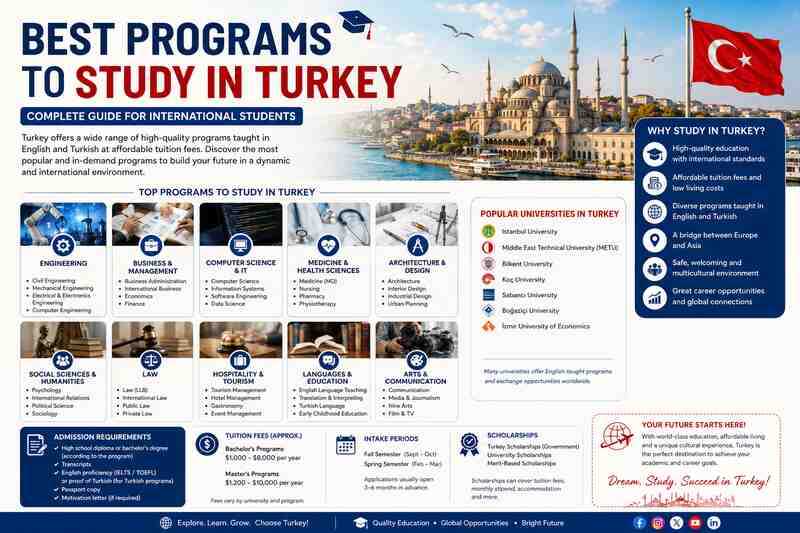
Best Programs to Study in Turkey - Complete Guide for International Students

AI Snapshot
Best Programs to Study in Turkey - Complete Guide for International Students — a quick summary from Turkey University to help students researching study options in Türkiye. Best programs to study in Turkey 2026: medicine, dentistry, nursing, engineering, CS and more. Fees, career outcomes, recognition. Free application now.
The best programs to study in Turkey in 2026 cover a wide range of fields, and the right choice depends entirely on where you want to be in five years not on which program sounds most impressive right now. Every week our team gets the same first question from students who have not decided yet: "What should I study in Turkey?" This guide answers that question properly.
Not with a list of popular programs and one sentence each. A real answer what each field involves, what career it leads to, how competitive admission is, what fees look like, whether Turkey is specifically good for that degree or just a convenient option, and which universities are strongest for it. We have covered the programs our students actually enroll in most, plus a few that are underrated and worth knowing about.
How to Choose the Right Program to Study in Turkey
When choosing what to study in Turkey as an international student, four separate questions are worth separating before you look at any list.
First: what will you be qualified to do after graduation? Every program has a different career ceiling. A nursing degree qualifies you to practice as a licensed nurse internationally. A business administration degree opens many doors but does not directly license you to do anything the career depends on what you build with it. Know which type of degree you are choosing.
Second: how hard is admission? Some programs in Turkey are genuinely competitive medicine and dentistry at public universities require high TR-YOS scores and limited seats. Private university health programs are much more accessible. Engineering and business at private universities have essentially open admission for qualified international students.
Third: what does recognition look like in your target country? A Turkish engineering degree with ABET accreditation carries weight in Gulf engineering firms. A Turkish medical degree from a WDOMS-listed university opens USMLE and PLAB pathways. A Turkish nursing degree requires the DHA or NMC licensing exam to practice in Dubai or the UK. Knowing this before you enroll means no surprises after graduation.
Fourth: is Turkey specifically good for this field, or just convenient? For medicine and health sciences, Turkey is genuinely one of the better choices for international students hospital infrastructure, clinical training quality, and recognized degrees. For architecture, Turkey's rich built environment and strong ITU and METU programs give graduates a real portfolio advantage. For some fields, Turkey is just fine. Not exceptional but solid and affordable.
Keep those four questions in mind as you read through the programs below.
1. Medicine - The Program Turkey is Best Known For
Medicine remains the most-searched program to study in Turkey among international students, and for good reason.
Duration: 6 years. Degree: Tip Doktoru (Doctor of Medicine). Admission: file-based for private universities (70%+ GPA), competitive for public (TR-YOS 90%+).
Turkey has more than 47 medical schools a higher density than almost any comparable country. Private universities like Medipol, Bahcesehir, Koc, and Aydin offer medicine in English with real clinical training in university hospital networks. Fees range from $12,500/year for Turkish medium at lower-tier private universities to $44,000/year for Medipol and Koc English programs.
Why Turkey is specifically good for medicine: Turkish medical universities in the World Directory of Medical Schools (WDOMS) graduate doctors eligible to attempt USMLE, PLAB, and other international licensing exams. The clinical infrastructure at Istanbul's major private hospitals is genuinely modern. Students from Arab countries find the recognition pathway back home straightforward.
What competitors do not tell you: public university medicine in Turkey is exceptionally competitive for international students. Most international applicants who get into medicine in Turkey go through private universities, where admission is accessible but fees are significant. Budget accordingly.
Fees at a glance:
Private (English): $16,000-$44,000/year
Private (Turkish): $12,500-$37,000/year
Public: $9,800-$12,000/year (TR-YOS required)
Career outcome: general practitioner after 6 years, then TUS exam for specialization in Turkey, or USMLE and PLAB for international pathways.
2. Dentistry - A Shorter Route to a Medical Career
Dentistry is the second most popular health program to study in Turkey, and in some ways the smarter financial choice for students who want a health career with strong job security without the six-year medicine commitment.
Duration: 5 years. Degree: Dis Hekimi (Dentist). Admission: file-based for private universities (60%+ GPA), competitive for public.
The five-year dentistry program covers preclinical sciences for two years then moves into intensive clinical rotations in university dental clinics from Year 3. Private universities like Yeditepe, Medipol, BAU, and Aydin all offer English-medium dentistry with modern simulation labs before students treat real patients.
Turkey has become a global dental tourism hub -- patients from Russia, Germany, the UK, and the Gulf fly to Turkey specifically for cosmetic dentistry and implants. This has pushed private dental clinics and hospital networks to invest heavily in equipment and clinical environments, which directly benefits students training in those same facilities.
Fees at a glance:
Private (English): $13,000-$67,000/year
Private (Turkish): $9,000-$35,000/year
Public: $8,000-$12,000/year
Recognition: Turkish dental degrees are recognized in Arab countries through bilateral agreements and in Germany through the Berufsanerkennung process. The UK pathway through the GDC Overseas Registration Examination is available for WDOMS-listed graduates.
Career outcome: dentist with general practice rights immediately after graduation. DUS exam for specialization in Turkey covering orthodontics, oral surgery, and periodontology. Germany and Arab countries offer the strongest international career pathways for Turkish dental graduates.
Read more at. studying Dentistry in Turkey for International Students
3. Physiotherapy and Rehabilitation - The Rising Star of Health Sciences
If there is one program to study in Turkey that is undervalued by students but trending hard in the global job market, it is physiotherapy and rehabilitation. Four years. No entrance exam. Fees from $2,900/year. A career that can take you to Dubai, Saudi Arabia, Germany, or the UK with the right licensing exam.
Duration: 4 years. Degree: BSc in Physiotherapy and Rehabilitation. Admission: file-based (60%+ GPA), no entrance exam.
Turkey's physiotherapy and rehabilitation programs at Medipol, BAU, Aydin, Gelisim, Atlas, and Kent are structured around the World Physiotherapy Confederation's international standards and the European Physiotherapy Education Network (ENPHE) framework. The UAE has roughly four physiotherapists per 10,000 people and is actively recruiting internationally. Entry-level physiotherapists in Dubai earn AED 4,000-8,000/month tax-free. Senior specialists in neurological rehabilitation or sports physiotherapy earn significantly more.
Turkey is a good country for physiotherapy specifically because it combines affordable fees ($2,900-$9,000/year), English-medium instruction, real hospital training, and a degree structure that meets the 1,000 clinical hours threshold that international licensing boards check.
Fees at a glance:
Kent University: approximately $2,900/year (cheapest English option)
Gelisim University: approximately $4,000/year
BAU and Aydin: approximately $5,500-$6,500/year
Medipol: approximately $8,000-$9,000/year
Internal links: Aydin University | BAU | Gelisim University | Kent University | Medipol University
4. Nursing - The Most In-Demand Healthcare Degree Globally
The WHO's State of the World's Nursing 2025 report puts the global nursing shortage at 5.8 million nurses. That gap will not close by 2030. For any student willing to complete four years of serious clinical training, this means a career with global job security that few other degrees can match.
Duration: 4 years. Degree: BSN (Bachelor of Science in Nursing). Admission: file-based (60%+ GPA), no entrance exam.
Turkey offers nursing in English at Medipol, Aydin, Gelisim, Kent, Altinbas, Atlas, and others. Fees range from $2,900 to $9,000/year. Clinical training is hands-on: Medipol nursing students rotate through a 700-plus bed hospital covering ICU, pediatrics, oncology, emergency, and maternity.
The career pathway to the Gulf is clear for Turkish nursing graduates: BSN degree, DataFlow credential verification, DHA or DOH or SCFHS licensing exam, licensed practice in UAE or Saudi Arabia within 3-6 months of application. Tax-free monthly salaries of AED 8,000-12,000 in Dubai for entry-level registered nurses, rising to AED 18,000-25,000 for ICU and specialist nurses.
Why Turkey specifically: English-medium instruction, real clinical training, affordable fees, and an established licensing pathway to the Gulf makes Turkey one of the most cost-efficient paths to a Gulf nursing career. Students who cannot afford UK or Australian tuition but want a recognized degree and a Gulf career have very few better options.
Fees at a glance:
Kent: approximately $2,900/year
Gelisim: approximately $4,000/year
Aydin and BAU: approximately $5,500-$7,000/year
Medipol: approximately $7,700-$9,000/year
5. Pharmacy - Shorter Than Medicine, Stronger Than Most Think
Pharmacy does not get enough attention in the study-abroad conversation, which is strange because it combines a solid science degree, manageable fees, no entrance exam, and consistent demand in Turkey and across the Arab world and Gulf.
Duration: 4 years. Degree: Eczaci (Pharmacist). Admission: file-based (60%+ GPA), no entrance exam at private universities.
The pharmacy program covers pharmaceutical chemistry, pharmacology, toxicology, microbiology, biochemistry, and clinical pharmacy, with practical components in university labs and hospital pharmacy rotations. English-medium pharmacy programs in Turkey are available at Medipol, Aydin, BAU, Altinbas, and Biruni.
Fees at a glance:
Private (English): $8,000-$16,000/year
Private (Turkish): $6,500-$13,000/year
Important note: Topkapi University's pharmacy program is Turkish-only always confirm the language of instruction before applying to any program.
Career: pharmacist in hospital pharmacy, community pharmacy, pharmaceutical industry, or regulatory affairs. Turkish pharmacy degrees are recognized in Arab countries through equivalence processes.
6. Engineering - Broad, Affordable, and Internationally Accredited
Engineering is the largest student category in Turkey by enrollment, and for good reason: fees are lower than health sciences, admission is accessible, and several Turkish engineering programs hold ABET accreditation that matters in Gulf engineering firms and international hiring.
Duration: 4 years. Degree: BSc in Engineering. Admission: file-based, generally accessible.
ABET (Accreditation Board for Engineering and Technology) is the globally respected engineering accreditation body recognized by employers in the UAE, Saudi Arabia, USA, and Europe. Istanbul Aydin University and Istanbul Gelisim University hold ABET accreditation for their engineering programs. When employers and licensing boards in ABET-accepting countries see the degree, it signals defined international competency standards not just a Turkish qualification.
Most popular specializations among international students: Computer Engineering, Civil Engineering, Mechanical Engineering, Electrical and Electronics Engineering, Industrial Engineering, and Biomedical Engineering.
Fees at a glance:
Public universities: $1,500-$4,000/year (TR-YOS may be required)
Private universities: $2,600-$8,000/year (no entrance exam for most)
Career in the Gulf: Engineering graduates targeting Gulf employers look specifically for ABET-accredited degrees because regional engineering licensing bodies (Saudi Council of Engineers, UAE Society of Engineers) use ABET recognition in credential evaluation. The ABET status of Aydin and Gelisim engineering programs matters specifically for Gulf-career students.
7. Computer Science and Software Engineering - The Digital Economy Degree
Computer science and software engineering sit separately from traditional engineering at some universities and deserve a standalone entry because the career trajectory is distinctly global.
Duration: 4 years. Degree: BSc in Computer Science or Software Engineering. Admission: file-based, accessible.
Turkey's best computer science programs are at METU (Middle East Technical University) and ITU (Istanbul Technical University) for public universities both internationally recognized and world-ranked in QS subject rankings. For private universities, Bilkent, Koc, Sabanci, and BAU are the strongest names. Even mid-tier private university computer science graduates have a career path not available in most fields: remote work for international companies, paid in USD or EUR.
A Turkey-based software engineer working remotely for a European or American company earns an average of $56,600/year in USD while living in Turkey where costs are significantly lower. Senior developers in fintech or AI earn $120,000 or more. That USD-salary-in-Turkey dynamic is specific to software and data engineering.
Fees at a glance:
Public universities: $500-$3,000/year
Private universities: $3,000-$8,000/year
Istanbul is a real tech city Trendyol (one of Europe's largest e-commerce companies by market cap), Getir, and dozens of well-funded startups are based there. Students who intern and network actively in Istanbul during their degree graduate into an environment with real opportunities.
8. Business Administration - The Versatile Foundation Degree
Business administration is the most widely enrolled program globally and Turkey is no exception. For students who want a recognized English-medium business degree at affordable fees without an entrance exam, Turkey's private universities offer solid options.
Duration: 4 years. Degree: BSc in Business Administration. Admission: file-based, very accessible.
The critical differentiator in business programs is accreditation. AACSB and EQUIS are the two most respected global business school accreditations. Koc University's business school has achieved Triple Crown (AACSB, AMBA, and EQUIS) -- placing it among fewer than 1% of business schools worldwide. Sabanci and Bilkent are also strong. For private universities accessible to international students without entrance exams, BAU and Aydin have solid business programs with international partnerships.
Fees at a glance:
Private universities (English): $2,900-$7,000/year
Public universities: $500-$2,000/year
Career outcome: business graduates have the widest career funnel covering finance, marketing, management, entrepreneurship, logistics, and HR but also the least direct licensing path. The career depends on what you build on top of the degree: internships, language skills, specializations, and postgraduate study.
9. Architecture - Where Turkey Has a Genuine Academic Edge
Architecture is underrated as a reason to study in Turkey. It is not just a convenient country to study design it is architecturally extraordinary, and that matters for design students in ways classroom-only environments cannot replicate.
Duration: 4-5 years. Degree: Bachelor of Architecture. Admission: file-based at private universities, competitive at METU and ITU.
Istanbul contains Byzantine churches, Ottoman mosques, early 20th-century apartment blocks, modernist state buildings, and cutting-edge contemporary architecture often within walking distance of each other. Istanbul Technical University and Middle East Technical University both rank in the top 100-150 globally for architecture and built environment in QS subject rankings. Studying architecture in Istanbul builds a portfolio that students in generic suburban campuses simply cannot develop.
Fees at a glance:
Public (METU/ITU): $1,000-$3,000/year (competitive admission)
Private universities: $3,000-$7,000/year
10. Psychology - Growing Demand, Often Overlooked
Psychology is an increasingly popular choice among international students, particularly from Arab countries, and Turkey has a growing number of English-medium psychology programs at private universities.
Duration: 4 years. Degree: BSc in Psychology. Admission: file-based, very accessible.
Turkish psychology programs at universities like BAU, Aydin, Uskudar, and Bilgi cover clinical psychology foundations, developmental psychology, social psychology, cognitive psychology, and research methods. Clinical psychology practice in most countries requires additional postgraduate training and licensing so the BSc is a foundation degree, not a direct license to practice clinically. But as an undergraduate degree, psychology builds strong analytical, research, and communication skills that translate into HR, counseling, education, mental health services, and organizational consulting.
The Arab world has growing awareness of mental health, and Turkish psychology graduates returning home with a recognized degree and clinical specialization focus are finding career opportunities that did not exist a decade ago.
Fees at a glance:
Private universities (English): $2,900-$6,000/year
Student Goal | Best Program Match | Why |
|---|---|---|
Want a medical career, can't afford 6 years | Dentistry or Pharmacy | 4-5 years, strong career, lower fees than medicine |
Want to work in Gulf healthcare | Nursing or Physiotherapy | Highest demand in Gulf, established licensing pathways, affordable fees |
Best career for lowest admission competition | Physiotherapy | Very low competition, growing international demand, fees from $2,900 |
Want degree flexibility and career options | Business Administration or Computer Science | Widest career funnel, remotely employable for tech |
Serious about medicine and have the grades | Medicine (private, English) | 6 years, significant investment, opens the most global doors |
Want to stay in Turkey and build a career | Computer Science or Software Engineering | Strongest local and remote salary trajectory |
Want to work in Germany | Physiotherapy or Dentistry | Germany has specific recognition pathways for both, documented shortages |
Want to design buildings | Architecture at ITU, METU, or private Istanbul uni | QS-ranked programs, Istanbul as living studio |
Budget below $5,000/year but want a health degree | Nursing or Physiotherapy at Gelisim or Kent | Legitimate accredited programs, cheapest English health science degrees in Turkey |
Regardless of which program you choose, the admission process for private Turkish universities is standard:
High school diploma (minimum approximately 60-80% GPA depending on program and university; medicine typically asks for 70-80%)
Valid passport (6 months minimum validity)
Official transcript, translated and certified into English or Turkish
Passport-size photos
Application form (university-specific)
No entrance exam is required at private universities for any of the programs in this guide including medicine and dentistry. This is a significant difference from most countries. Public universities require TR-YOS for medicine, dentistry, and competitive programs.
Health science programs fill faster than other programs medical seats especially are limited by YOK regulations on international student quotas. Apply between January and March for September enrollment. Do not wait until summer.
We are an Istanbul-based agency with offices in Fatih, not a remote call center. When you apply through us, you get:
Zero application fees. The 75-plus universities we work with pay us directly. We never charge students.
24-hour admission letters. Once your documents are complete, we deliver an acceptance letter within one working day. This matters for visa timelines.
Sworn translation authority in Istanbul. We have our own court-accredited translation service. Documents we authenticate are legally valid for government processes without re-notarization. Students who sort document authentication elsewhere often run into problems at the Turkish Ministry of Education equivalence (denklik) office.
On-ground arrival support. VIP airport pickup, residence permit appointment, university registration, course selection -- our team is there for all of it in person.
21 years of operation. Over 100,000 applications processed and more than 10,000 students enrolled. The agency track record is real and verifiable.
Whatever program you choose from this guide apply through turkeyuniversity.org. Zero fees, 24-hour response, and a personalized university comparison matched to your grades, budget, and career goals.
Read more at.
1- Best University Admission Offices in Turkey for International Students.
Turkey's higher education system has become one of the most practical destinations for international students who want English-medium programs, real clinical or technical training, recognized degrees, and a cost structure that does not require their family to go into debt. The key is matching the right program to your actual career goal not the most prestigious-sounding name.
Our team has guided over 10,000 students through this decision over 21 years. Apply at turkeyuniversity.org with zero fees, and within 24 hours our advisors send you a personalized comparison of which programs and universities match your background, budget, and where you want to be in five years.
Q: What are the best programs to study in Turkey for international students? A: For Gulf healthcare careers, nursing and physiotherapy have the best combination of affordability, demand, and clear licensing pathways. For medicine, Turkey offers strong programs but costs are significant. For engineering and tech, Turkey offers ABET-accredited programs and a real tech ecosystem in Istanbul. For architecture, Turkey's built environment is genuinely unmatched as a study context.
Q: Which Turkish programs are internationally recognized? A: Medicine degrees from WDOMS-listed universities are recognized for USMLE and PLAB pathways. Nursing degrees are recognized in the Gulf through DHA, DOH, and SCFHS registration. Physiotherapy degrees aligned with World Physiotherapy standards meet international benchmarks. Engineering programs with ABET accreditation (Aydin, Gelisim) are recognized by Gulf and US engineering licensing bodies. Business programs from AACSB-accredited schools (Koc) carry global employer recognition.
Q: What is the easiest program to get into in Turkey as an international student? A: At private universities, essentially all programs have accessible admission -- 60%+ GPA, high school diploma, valid passport, no entrance exam. Medicine at private universities asks for 70-80% GPA, slightly higher but still file-based. No YOS, no IELTS required at any private university for any program in this guide.
Q: Which program in Turkey has the best return on investment? A: From a pure financial perspective, nursing and physiotherapy are arguably the highest ROI relatively low total cost ($12,000-$36,000 over four years), direct licensing pathways, and tax-free Gulf salaries of $2,200-$4,900/month. Software engineering has exceptional upside for remote work for international companies. Medicine has the highest career ceiling but the highest cost and longest time to income.
Q: Is Turkey good for postgraduate Master's study? A: Yes. Master's programs in Turkey run $3,000-$9,000 total program fees for two years in most fields not per year. For students specializing after their bachelor's (nursing management, sports physiotherapy, clinical psychology, business analytics), Turkey is one of the most cost-efficient places in the world to do it.
Q: Which programs to study in Turkey lead directly to Gulf careers? A: Nursing and physiotherapy have the most direct Gulf pathways both fields have documented shortages in the UAE and Saudi Arabia, established licensing exams (DHA, DOH, SCFHS Prometric), and entry packages that include housing. Medicine and dentistry also have Gulf pathways but the licensing process is more complex and competitive.